
Elise Gomes

Extensions, courses and certifications
What course do you take to work as a UX Designer, Product Designer, Product Owner, etc? It is very common for me to receive this type of question. I actually took several courses that focused on many different aspects of my job. This is a place where I intend to record the courses I've enjoyed and share my honest opinions about each course.
But why register this?
Many young artists come to me asking what class I took for this and that... Since I've already written many emails answering these questions I decided to create a page (very simple, by the way) to complement this exchange of experiences and make life easier for the shy ones who are too shy to ask these questions directly to me... I don't bite :P
Technical Development
University Graduation Diploma, Postgraduate and Extension


Social Communication
Marketing
(Graduation - 2005)
Bachelor of Technology - BTech, Web Design, Webmaster
(University Graduate)
Animation and 2D and 3D Digital Art
(Postgraduate Studies)
What I liked the most about this course
First contact with concepts of color psychology , typography, brand positioning in the market , branding and visual identity.
At the time, there was not much talk about marketing on social media. We used Orkut, which needed an invitation to enter. The internet "was all bush" .
It was with this course that I learned to work with Photoshop and Illustrator . I learned to use a professional camera and develop analog photographs in the lab , my favorite place to pass the time.
I ended up focusing on Web Design while her husband (who was studying Systems Analysis and Development) helped with the programming part, which wasn't very heavy in this course... we used more markup language.
I realized that I like to pay special attention to the User Interface and I try to make the website / application / game as friendly as possible.
At this point I was already mixing the two courses and started making digital games with my husband on weekends... just for fun.
I had a lot of difficulty editing videos and I decided to fill up this need with a. post-grad.
As a bonus I learned more 3D modeling techniques using Zbrush, which allows me to make digital sculptures. A bit of Blender later in "the game".
TCC focused entirely on the Psychology of Colors in cinema and its associations to emotions that are capable of awakening in each scene..

The Language of Design:Form and Meaning
(by California Institute of the Arts | CALARTS)
In my own translation to Brazilian Portuguese:
A linguagem do design: forma e significado
A course focused on the technical language of Design. It helped with a lot with new terms, mainly because it was an all-English course. I recommend it to anyone who also needs to expand their vocabulary and more technical knowledge.

Design: Creation of Artifacts in Society
(by University of Pennsylvania)
In my own translation to Brazilian Portuguese:
Design: Criação de Artefatos na Sociedade
Theory and practice very well balanced with weekly challenges to be done throughout the course.
The classes taught by the vice dean Karl T. Ulrich played a key role in developing my ability to solve problems for my clients in a more efficient way, as the teacher approaches the Design process and its stages very well until reaching the final product.
The course covers Design in a very broad way and even talks about product design, architecture and services ... which for me was fantastic in the development of my own brand products, making them more interesting and allowing me to offer better services to my clients.

Even though I've been applying Design Thinking principles in my work for years , this course was a valuable reminder that knowledge is a living thing that needs to be reinforced and renewed. By revisiting each stage, from exploration, through creation and reflection, to implementation, I was able to recognize practices that are already part of my daily routine and, at the same time, discover new ways to make them more structured and collaborative.
Developing Other Skills
I am naturally curious. I enjoy learning, exploring different fields, and understanding how people think, communicate, and interact with the world. Not everything I study is directly related to Design, but I almost always find ways to transform that knowledge into tools for creating more human-centered experiences.
Beyond technical skills, I believe that growing as a professional also means developing empathy, communication, critical thinking, and interpersonal skills. The studies in this section were driven by that curiosity and by my constant desire to grow—not only as a designer, but also as a person.

Clinical Psychoanalysis
Currently Studying
(by IBPC, Brazilian Institute of Clinical Psychoanalysis - 2021)
Studying Clinical Psychoanalysis broadened my understanding of human behavior, cognitive processes, and the ways people interpret experiences, information, and stimuli. Beyond the theoretical knowledge, it also contributed to an important process of self-awareness, helping me recognize my own biases, assumptions, and patterns of interpretation.
This awareness has become a valuable asset in user research and UX/UI decision-making. By understanding that every interpretation can be influenced by personal experiences, I have developed more structured research practices, striving to base conclusions on evidence while minimizing, whenever possible, the influence of individual biases.
The study of Clinical Psychoanalysis also strengthened my skills in active listening, observation, and empathy; essential competencies for understanding users' real needs beyond what is explicitly expressed. This perspective supports the creation of more intuitive, accessible, and human-centered interfaces, making my design process more thoughtful, ethical, and focused on delivering meaningful user experiences.

Healing with the Arts
(by University of Florida)
Endorsed by
Dr. Jean WatsonandWatson CaringScience Institute

In my own translation to Brazilian Portuguese:
Curando com a Arte
The course revisited concepts of Color Psychology, exploring the emotions different colors evoke and how this knowledge can be applied to designing more intuitive, accessible, and user-friendly interfaces for software and games. It was interesting to see how each color conveys different feelings and how these principles can also improve the experience for people who perceive colors differently, reinforcing the importance of accessibility in design.
The course took a broad approach, covering visual arts, music, and dance while emphasizing how color influences human perception, well-being, and the way users interact with digital interfaces.

Art teacher preparation program
(380 hours)
I chose this extension because I already had a strong foundation in artistic techniques, allowing me to focus on teaching and learning processes. The course helped me develop clearer, more progressive, and natural ways of communicating knowledge.
This learning has contributed to my work in UX/UI and Game Design, particularly in creating tutorials and onboarding experiences, helping me understand how to guide users and players intuitively, accessibly, and without overwhelming them.

Oil painting
(140 hours)
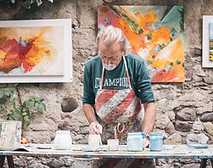
I explored oil painting as a way to return to the fundamentals of visual representation, setting aside digital painting tools to deepen my understanding of light, shadow, volume, and texture. From these techniques, I developed a digital painting approach based on traditional painting principles.
This knowledge can also be applied to texture painting for 3D models, using painted light and shadow to create the perception of volume and depth. This approach can achieve richer visual results without relying exclusively on a high polygon count.
Art Therapy
(550 hours)
Art Therapy marked the beginning of my journey into Accessibility. The course introduced me to the importance of adapting tools, spaces, and experiences to different needs, making it possible for people with different ways of interacting and expressing themselves to access art.
This first experience with accessibility in an analog context became the foundation for a journey that later led me to Digital Accessibility. Today, these principles are part of my work in creating more accessible interfaces and experiences for software and games.

_edited.png)
International Certification in Color Therapy
(Prof Krishna Sharma, Ph.D.)
After years of studying Color Psychology in different contexts, I explored Chromotherapy as a more specific approach to the relationship between colors, perception, and emotional responses. The certification allowed me to deepen this area of study and explore different associations attributed to colors, expanding my understanding of visual perception.
As with my other studies, my goal was to understand, analyze, and select what could contribute to my professional practice. This knowledge became an additional perspective within my Design studies, helping me reflect on the intentional use of color in interface design, considering context, perception, visual hierarchy, and user experience.
Personal project
It may seem unusual to think about Dog Training when talking about UX (User Experience), but studying canine cognition and behavior became a small personal case study in communication, learning, and interaction design.

Dog Emotion and Cognition
(by Duke University)
To read more about this subject: How I Teach My Dogs to Talk.

In my own translation to Brazilian Portuguese:
Emoção e Cognição Canina
Through positive reinforcement, I realized that I was essentially building a communication interface: positions, gestures, and objects functioned as visual and interactive elements that the dogs learned to recognize.
Consistency also proved essential; as when a user can get lost after someone changes the position of apps on their phone, dogs also develop expectations through repetition and environmental organization. This project allowed me to observe firsthand how patterns, feedback, and predictability influence the way different individuals learn and interact with a system.